Tell us about the job
Takes about a minute. No obligation.
Homes in Sevier County, UT run heat about ten months a year, from September through June. A furnace cycling through that kind of calendar puts the heat exchanger, burner, and ignition system through repeated stress across most of every year, and those are the parts that show it first. A contractor called out for a repair here checks igniter condition and heat exchanger integrity before chasing other causes, because the cumulative load on combustion components is real. The idle window is short, which means a marginal part rarely recovers on its own.
Furnace repair in older housing stock often stalls at one specific point: the parts list. Half the homes in Sevier County, Utah were built in 1977 or earlier (2020-2024 ACS 5-year). A unit that has been running in a house that old has likely had components cycle through availability once or twice already. When a contractor opens the heat exchanger or pulls the control board, what they find may be a part number a distributor can still source or one that went out of production years back, and that answer changes whether a repair is a same-week fix or a longer conversation about what comes next.
The Parts of a Furnace a Contractor Checks First
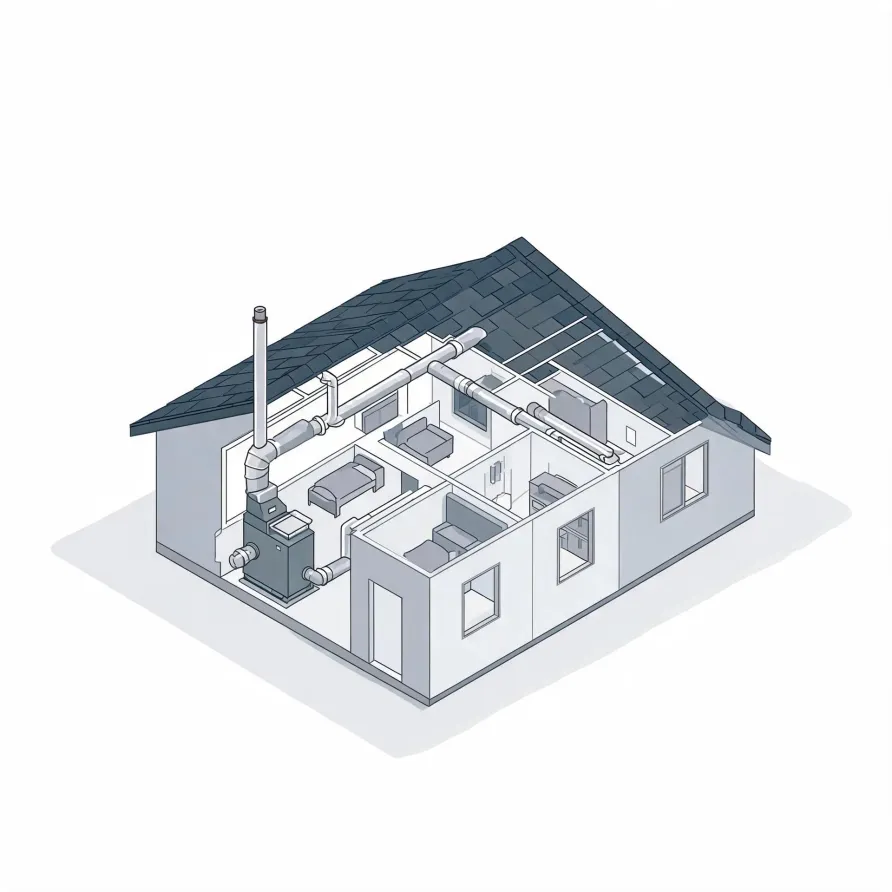
The furnace itself sits in a utility space, basement, or closet and is the heart of the system. Inside it, the heat exchanger, burner assembly, and blower motor are the pieces a contractor goes to first when something is wrong. A cracked heat exchanger, a dirty or failed burner, or a blower that has stopped moving air each produces its own set of symptoms.
The flue pipe runs from the furnace to the outside and handles exhaust; a blockage or a break there shows up fast. The thermostat on the wall and the limit switch inside the cabinet both tell the furnace when to fire and when to stop, and either one can send the system into a fault cycle when it fails.
The drawing shows a typical furnace layout, and a licensed contractor determines which parts apply to the specific system and setup in your home.
Get matched in Sevier CountySevier County, by the numbers
65 severe weather events were recorded in Sevier County, Utah between 2015 and 2024.
NOAA National Centers for Environmental Information, Storm Events Database, bulk CSV export, events 2015-01-01 through 2024-12-31.Half the homes in Sevier County, Utah were built in 1977 or earlier (2020-2024 ACS 5-year).
U.S. Census Bureau, 2020-2024 American Community Survey 5-Year EstimatesSevier County, Utah holds 8,831 housing units (2020-2024 ACS 5-year).
U.S. Census Bureau, 2020-2024 American Community Survey 5-Year EstimatesOwners occupy 77.8% of the occupied homes in Sevier County, Utah (2020-2024 ACS 5-year).
U.S. Census Bureau, 2020-2024 American Community Survey 5-Year EstimatesCodes & Standards Governing Furnace Repair in Sevier County, Utah6 sourced rules and standards
What Happens Once a Contractor Comes Out
Non-weatherized gas furnaces manufactured on or after November 19, 2015 must reach 80.0 percent AFUE.
Non-weatherized oil-fired furnaces manufactured on or after November 19, 2015 must reach 83.0 percent AFUE.
Mobile home gas furnaces manufactured on or after November 19, 2015 must reach 80.0 percent AFUE.
Non-weatherized gas furnaces manufactured on or after December 18, 2028 must reach 95.0 percent AFUE, up from the 80.0 percent minimum that applies to units manufactured before that date.
Licensing Rules for HVAC Repair in Sevier County, Utah
Utah’s contractor licence does not reach alteration, repair, remodelling or improvement of a building worth less than $7,000 in labour and materials together, counting every change and addition to the agreed work — though the plumbing and electrical trades are pulled back under licensure even below that figure.
Utah requires a state licence before engaging in a licensed construction trade or contracting activity, and HVAC contractor is one of the licence classifications the state issues.
Severe Weather Events in Sevier County
Sevier County's climate puts real stress on furnaces, and that stress compounds over time. How hard local weather pushes heating equipment shapes how often repair needs come up and what those repairs tend to involve.
65 severe weather events, 2016–2024. Source: NOAA National Centers for Environmental Information, Storm Events Database.