Tell us about the job
Takes about a minute. No obligation.
Sizing and installation quality matter more here than in counties where a furnace sits idle for half the year. Homes in Duchesne County, UT run heat about ten months a year, from September through June. The burner, heat exchanger, and ignition system cycle through that span with little downtime, so any weakness in the original installation is working against the equipment almost continuously. A contractor quoting a replacement has to account for that load before settling on equipment capacity, because undersizing in a county with this kind of heating demand accelerates wear on the parts that cannot rest.
Ductwork sized and routed for an older furnace does not simply accept a replacement unit. Half the homes in Duchesne County, Utah were built in 1986 or earlier (2020-2024 ACS 5-year). That history means a contractor opening the system in a typical Duchesne County home will find runs, returns, and trunk lines laid out around a load calculation that no longer applies. Whether the existing ductwork can carry the new furnace without rebalancing or partial replacement is the question that shapes the job, and the electrical service behind the furnace gets the same scrutiny for the same reason.
What Gets Installed With a New Furnace
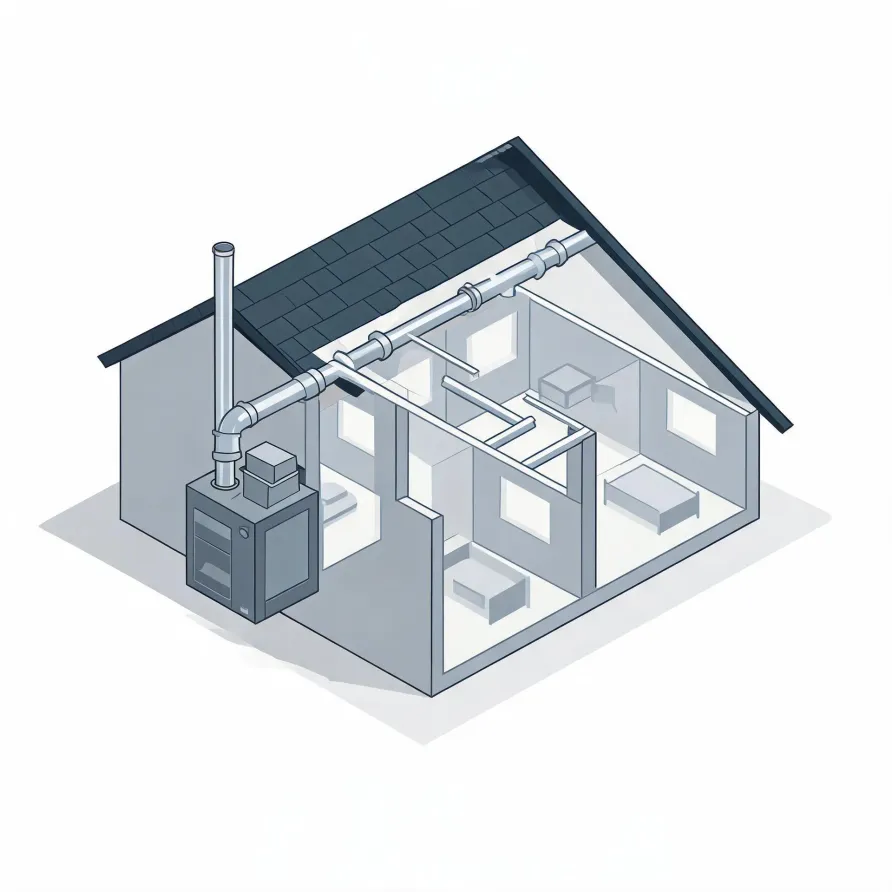
The furnace itself sits in a mechanical room, basement, or utility closet and is the core of what a contractor puts in. A heat exchanger lives inside that cabinet, and a blower motor forces air across it and out into the house. These are the pieces a homeowner is buying when they buy a new furnace.
The flue pipe runs from the furnace cabinet up and out of the house, carrying combustion gases away. A thermostat goes on a main living-area wall and is the control point for the whole system. On gas furnaces, a gas valve and an igniter also get placed inside the cabinet during installation.
The drawing shows a representative layout, and a licensed contractor determines what fits the configuration of your specific home.
Get matched in Duchesne CountyDuchesne County, by the numbers
88 severe weather events were recorded in Duchesne County, Utah between 2015 and 2024.
NOAA National Centers for Environmental Information, Storm Events Database, bulk CSV export, events 2015-01-01 through 2024-12-31.Half the homes in Duchesne County, Utah were built in 1986 or earlier (2020-2024 ACS 5-year).
U.S. Census Bureau, 2020-2024 American Community Survey 5-Year EstimatesDuchesne County, Utah holds 9,028 housing units (2020-2024 ACS 5-year).
U.S. Census Bureau, 2020-2024 American Community Survey 5-Year EstimatesOwners occupy 78.9% of the occupied homes in Duchesne County, Utah (2020-2024 ACS 5-year).
U.S. Census Bureau, 2020-2024 American Community Survey 5-Year EstimatesFurnace Installation Rules & Codes for Duchesne County, Utah6 sourced standards and regulations
What HVAC Installation Looks Like in Duchesne County
Non-weatherized gas furnaces manufactured on or after November 19, 2015 must reach 80.0 percent AFUE.
Non-weatherized oil-fired furnaces manufactured on or after November 19, 2015 must reach 83.0 percent AFUE.
Mobile home gas furnaces manufactured on or after November 19, 2015 must reach 80.0 percent AFUE.
Non-weatherized gas furnaces manufactured on or after December 18, 2028 must reach 95.0 percent AFUE, up from the 80.0 percent minimum that applies to units manufactured before that date.
Licensing and Legal Requirements in Duchesne County, Utah
Utah’s contractor licence does not reach alteration, repair, remodelling or improvement of a building worth less than $7,000 in labour and materials together, counting every change and addition to the agreed work — though the plumbing and electrical trades are pulled back under licensure even below that figure.
Utah requires a state licence before engaging in a licensed construction trade or contracting activity, and HVAC contractor is one of the licence classifications the state issues.
Severe Weather Events in Duchesne County
Weather in Duchesne County puts real demands on heating equipment, from the load a furnace carries through hard winters to the stress that weather extremes place on components over time. How often those conditions arrive shapes what a furnace installation here needs to handle.
88 severe weather events, 2015–2024. Source: NOAA National Centers for Environmental Information, Storm Events Database.